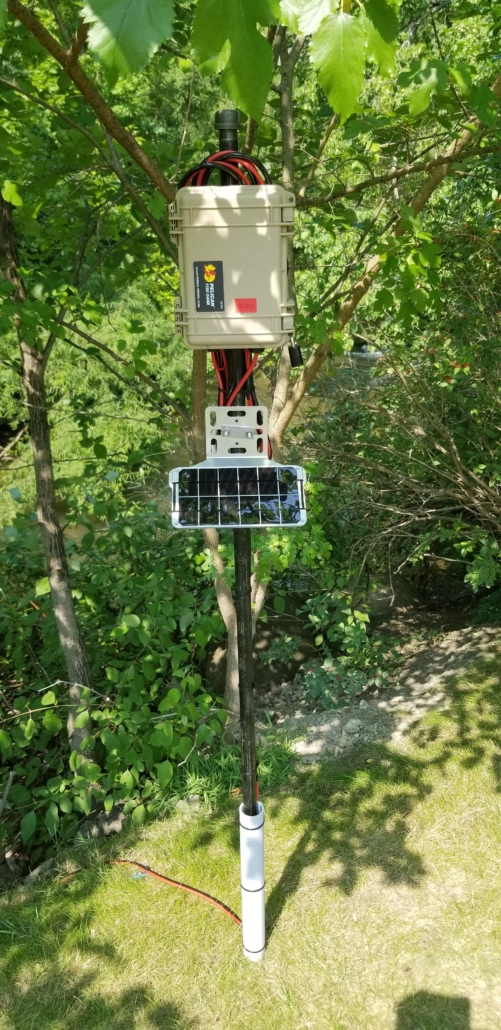
Josh works with Trout Unlimited’s Jake Lemon in maintaining and recording our monitor data. Friends of Buck Creek appreciate their expertise!
Friends of Buck Creek’s “Monitor My Watershed” station measures the water quality of Buck Creek. We are able to gather data on temperature (°F), dissolved solids (μS/cm), and water level (in). With this information we can determine needed green infrastructure, such as rain gardens and curb cut gardens along parking lots that prevent contaminated road runoff from reaching the stream. Native trees planted near the creek lower water temperature. Cold temperatures are a crucial metric for a healthy trout population since fish are sensitive to warmer waters with less oxygen. Conductivity monitors how much dissolved solids are in the water and can indicate how many contaminants are present.
Data Summary:
This year registered the highest temperatures since we started collecting data at this site. This is likely due to the hot summer combined with very little rainfall. On 06/21/2025, we saw a recorded temperature of 82.0°F. The mean temperature was 54.0°F, and our lowest recorded temperature was 33.1°F.
For electrical conductivity, the average was 1144.70 μS/cm with a high of 2529.8 μS/cm, and the minimum was 253.3 μS/cm. This is fairly typical for Buck Creek; however, encouraging homeowners to reduce the fertilizer runoff by planting native plants on lawn edges and leaving a buffer zone may help reduce overall conductivity. Another way to lower conductivity is through the use of rain gardens to reduce road/stormwater runoff. (Partnering with Grandville Public Schools, Friends of Buck Creek installed a major rain garden project at the Grandville Middle School, now Oakestown Intermediate School.)
Stream depth data, recorded a high of 41.8 in, a mean of 8.24 in, and a low of 2.5 in. We recorded our lowest water depth of 2.5 in (07/28/2025) since we started recording at this site. This is likely due to the extreme heat and drought in the west Michigan area in July and August.
We saw some extremes this year in the form of temperature and water depth. These are a direct result of 2025’s drought and high temperatures. While conductivity remained fairly normal, there is still room for improvement. Planting native trees, grasses, and sedges will shade the stream and help restore the banks to prevent runoff. It takes a community to love Buck Creek!

